

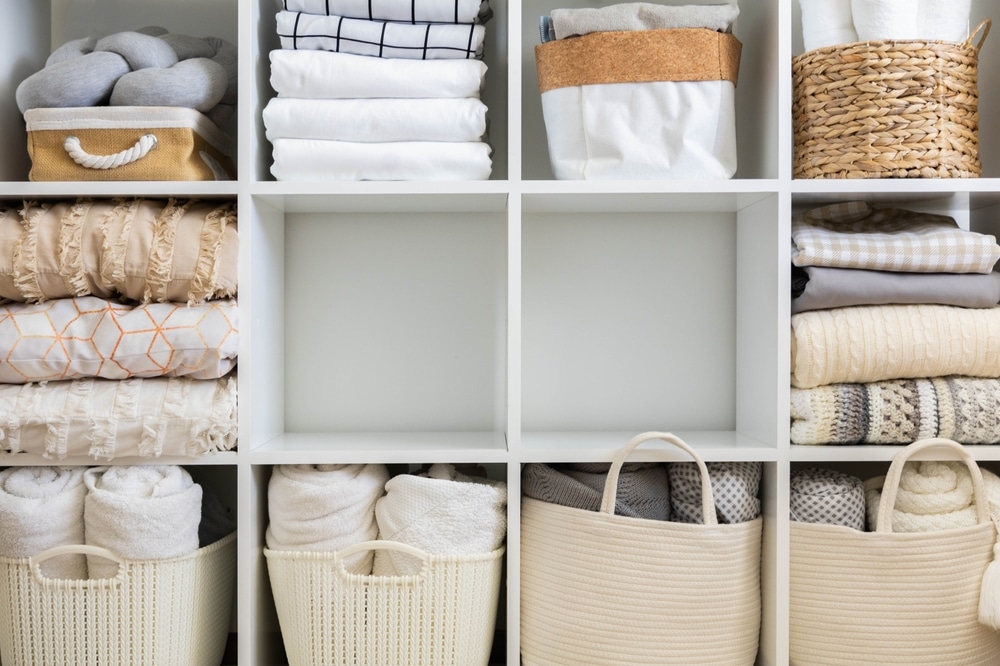
There’s a particular betrayal that comes from a freshly organized linen closet collapsing back into chaos within seven days. You spent a Saturday afternoon folding fitted sheets like a person possessed, you bought matching baskets, you maybe even labeled things — and by the following weekend, it looks like a textile crime scene again. The problem isn’t that you’re disorganized. It’s that most advice on how to organize your linen closet treats it like a one-time decorating project instead of a system that has to survive real life. Real life is messy. Towels come out of the dryer. Sheets get changed. Guests rummage. Kids reach for things and put them back wrong.
The trick to organization that actually lasts is designing it to withstand all of that. Let’s get into how.
Why Linen Closets Fall Apart
Before fixing anything, it helps to understand why these closets fail so reliably. Linen closets are some of the most diverse storage spaces in any home — sheets in three different sizes, bath towels and hand towels and washcloths, guest linens, decorative pillows, sometimes blankets, sometimes medicine, sometimes random toiletries. That’s an enormous variety of objects in an enclosed space, and the more diverse the contents, the harder it is to maintain order.
Most people try to organize your linen closet by neatly stacking everything on shelves. The neat stacks are exactly the problem. Stacks are inherently unstable. The moment you pull something from the middle, the whole tower collapses. Anyone trying to organize your linen closet using stacks alone is essentially building a system that’s designed to fail.
The closets that stay tidy long-term don’t rely on stacks. They rely on contained, grouped, vertical-friendly systems that handle being disturbed.

Start With the Brutal Purge
There’s no skipping this step. Before you touch any baskets or labels, you have to get everything out. Lay it all on the bed or the floor. Look at what you actually own. Then be ruthless.
Most linen closets contain at least 30% items that don’t need to be there. The flannel sheets you bought one cold winter and decided were too hot. The twin sheets from when your kids were small. The towels that have been “almost too thin” for five years. The mystery pillowcase whose match has been missing since 2021. Donate, dispose, or relocate. The single most important move when you organize your linen closet is reducing the volume — every system works better with less stuff in it.
A good rule: keep two complete sheet sets per bed (one on, one in the wash rotation), and three to four bath towels per person in the household. Anything beyond that is excess unless you have a specific reason for keeping it.
While the closet is empty, this is also a great moment to wipe it down. Maybe even paint it or add peel-and-stick wallpaper to the back wall. Sounds frivolous, but several professional organizers note that people are dramatically more motivated to maintain a closet that looks nice. Treating it like a real space, not just storage, makes a difference.
Group by What You Actually Use Together
The biggest mindset shift in lasting organization is grouping by use, not by appearance. It’s tempting to organize your linen closet by visual category — all towels here, all sheets there. That looks tidy on day one. It does not survive contact with real life.
Instead, think about what gets used together. A queen sheet set is one bundle. A guest bedroom kit (sheets, pillowcases, an extra blanket) is one bundle. A beach day pile (oversized towels and a sand-friendly throw) is one bundle. When you organize your linen closet by use-case, putting things back becomes obvious and effortless. You’re not searching for the right pillowcase to match a sheet — the pillowcase lives inside the sheet.
The classic trick that makes this work: tuck a sheet set inside one of its own pillowcases. The whole bundle becomes a single, neat, self-contained package. You grab one pillowcase off the shelf and have everything you need to make the bed. This single change is what separates linen closets that stay organized for a week from ones that stay organized for a year.
Containers Matter, But Choose Wisely
Now the fun part — bins, baskets, and containers. They genuinely help, but only if you choose them right.
Open-top fabric or wire baskets work better than closed bins for most linen closet uses. You want to be able to see what’s inside without lifting a lid. Lids add friction, and friction is the enemy of maintenance. If pulling something out requires three steps, people stop putting it back.
Use baskets for the small chaos: washcloths, hand towels rolled up like a spa, guest toiletries, medicine, sunscreen, that kind of thing. Use larger bins for category groupings — a bin for guest bedroom linens, a bin for seasonal blankets, a bin for backup toilet paper. When you organize your linen closet using contained zones, individual items can be a bit messy inside the basket without destroying the appearance of the whole closet. Mess inside a labeled basket reads as “fine.” Mess on an open shelf reads as “disaster.”
Don’t overspend. IKEA, HEMA, Action, and Søstrene Grene all carry perfectly functional baskets and bins. Matching containers look the most polished, but they’re not strictly necessary — even a mix of similar-toned baskets reads as intentional.
The Roll vs. Fold Debate
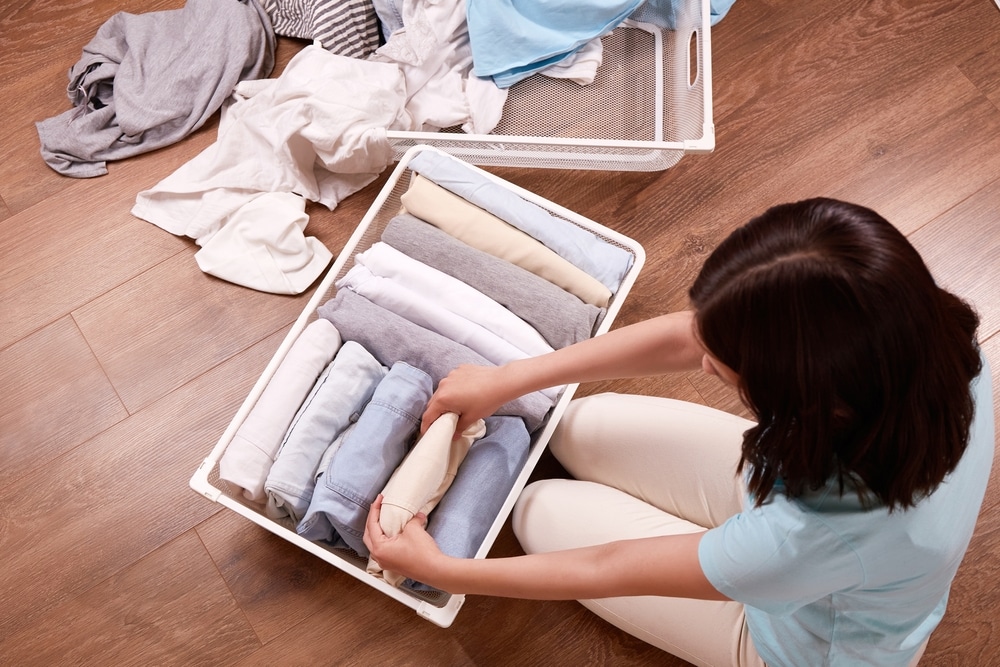
How you fold makes a real difference. Stacked, folded towels look great in a magazine and fall apart constantly in real life. Rolled towels — like in a spa — take up less depth, are easier to grab, and don’t disturb their neighbors when you pull one out.
For deep shelves, roll your bath towels and stand them upright in a basket like wine bottles. For sheet sets, fold them into compact bundles inside a pillowcase as described above. For thin items like washcloths or small hand towels, magazine file holders (yes, the cardboard kind from any office store) keep them upright and accessible.
The specific folding method you choose matters less than committing to it consistently. The reason organized closets fall apart is usually that things get folded one way today and a different way next week. Pick a method when you organize your linen closet and stick to it.

Use the Door (Yes, Really)
The inside of the closet door is the most underused real estate in any storage space. A slim over-the-door rack, a wire basket system, or even a simple hanging organizer adds significant storage without taking shelf space.
This is where toiletry overflow lives — extra shampoo, sunscreen, mouthwash. It’s where you stash an ironing board if you have one. It’s where the random small items that have nowhere else to go finally have a home. Adding door storage to a small linen closet can effectively double the usable space, which alone makes it worth the €15-30 investment.
Shelf Dividers: The Invisible Hero
If your linen closet has long shelves, vertical dividers are a small purchase that pays off forever. They keep stacks from leaning into each other and turning into one continuous pile of fabric. They also create defined zones — a section for sheets, a section for towels, a section for bedding — that the eye can read at a glance.
Acrylic dividers from IKEA or Amazon cost around €8-15 for a set. Wire dividers work too. Some people even use cut-down cardboard for a free version. Whatever you use, dividers are what make organization survive a year of real-world use. When you organize your linen closet without dividers, the system erodes by week three. With them, it lasts.
Label Even If You Live Alone
Labels feel excessive when you’re the only one using the closet. Do it anyway. Labels do two things that matter beyond their visual appeal: they tell future-you (or anyone else) where things go, and they create a small psychological commitment that makes you put items back correctly.
You don’t need a fancy label maker. Chalk markers on baskets, simple printed tags, or even masking tape with a Sharpie works. The point is that when you reach in tired at 11pm and pull something out, the label tells you where it goes back without you needing to think.
Keep a Small Buffer for Real Life
The best linen closets aren’t fully packed. They have empty space — a buffer for the laundry that came out of the dryer late, the guest bedding waiting to be washed, the seasonal swap. Cramming every shelf to capacity guarantees the system fails the first time anything’s slightly off-cycle.
Aim for about 80% capacity. That margin is what allows the closet to absorb the chaos of normal life without descending into disorder. When professional organizers organize your linen closet, they almost always leave more empty space than the homeowner expected. This is intentional.
The Maintenance That Actually Sustains It
A thoughtfully organized linen closet still requires light upkeep. The good news: it’s about five minutes a month, total.
Once a month, take 60 seconds to scan the closet. Anything obviously out of place? Put it back. Any baskets overflowing? They might need a re-sort. Once a season, do a deeper check — rotate older towels to the front, refresh the open box of baking soda you’ve stashed in the back to keep things smelling neutral, and donate anything that’s accumulated unnecessarily.
This is the rhythm that keeps the work you did on the original organization holding for years instead of weeks.
To organize your linen closet so it lasts, the rules are simple. Purge ruthlessly. Group by what you use together. Bundle sheet sets inside pillowcases. Use containers and shelf dividers to fight collapsing stacks. Roll towels for compact, accessible storage. Use the inside of the door. Label things. Leave a buffer of empty space. Do a five-minute monthly check.
That’s the whole system. The reason it lasts isn’t that it’s elaborate — it’s that it’s designed to survive being used by real humans on real days. Now go take everything out, and start over the right way. Your linen closet has been waiting.
Do you want more amazing tips to reorganize your home? Then visit our home organization page right here