
There’s a strange truth about interior design that nobody mentions enough: the cheapest item in the room often does the most heavy lifting. You can spend thousands on a sofa and still have a space that feels unfinished, but throw down the right rug — even a budget one — and suddenly the whole room clicks into place. If you’ve been wondering why your living room or bedroom feels “off” despite all the effort you’ve put in, the answer might literally be lying on the floor (or rather, not lying on the floor). The good news? Affordable rug ideas are everywhere these days, and a well-chosen one can completely transform a space without draining your bank account.
This is one of those decorating moves where being broke actually doesn’t matter. You just need to know what you’re doing.
Why Rugs Are the Secret Weapon of Interior Design
Designers have known this for years: rugs anchor a room. They define spaces, soften hard floors, dampen sound, add warmth, introduce color and texture, and pull disparate pieces of furniture into a coherent whole. A room without a rug often feels like an unfinished sentence. A room with the right rug feels like a complete thought.
The reason this matters for budget decorating is simple: rugs deliver more visual impact per euro spent than almost any other decor item. A €60 rug can change how a room feels more dramatically than a €200 lamp. When you start hunting for affordable rug ideas, you’re not “settling” for cheap — you’re playing a smart game. The trick is knowing what to prioritize and what to skip.

Size Matters More Than You Think (And Probably More Than Quality)
Here’s the single most common mistake people make when shopping for rugs: they buy too small. A tiny rug floating in the middle of a room looks awkward, makes the space feel disjointed, and quietly screams “I bought what was on sale.” A correctly-sized cheaper rug always looks better than a beautiful expensive rug that’s too small.
Use these basic rules. In a living room, the rug should be large enough to fit at least the front legs of all your major furniture pieces — ideally all four legs if your room allows. Standard sizes start at 200×300 cm and go up from there. In a dining room, the rug should extend at least 60 cm beyond the table on every side, so chairs stay on the rug when pulled out. In a bedroom, aim for a rug that extends 45 to 60 cm beyond the bed on each side, or use runners on either side.
When you’re hunting for affordable rug ideas, prioritize size over fanciness. A simple, larger rug from IKEA or HEMA will look more expensive than a small “fancy” rug from anywhere.
Where to Actually Find Cheap Rugs That Look Good
Now we get practical. The rug industry is enormous, and prices range from “ten euros at a market stall” to “more than your car.” Most affordable rug ideas worth pursuing live in a few specific places.
IKEA is the obvious starting point. Their MORUM and TIPHEDE collections offer flatweave rugs in larger sizes for under €50. The STOENSE and LANGSTED options are surprisingly plush for the price.
HEMA, Action, and Søstrene Grene carry smaller and accent rugs in trendy patterns at very low prices. Don’t expect heirloom quality — but for a kitchen or entryway, they’re perfect.
H&M Home and Zara Home sit in the slightly-pricier-but-still-cheap zone, with surprisingly chic options if you catch their sales.
Marktplaats, Vinted, and local Facebook groups are gold mines. Vintage and second-hand rugs often look more expensive than brand-new budget options because they have actual character. A used wool rug in good shape for €40 will outclass a €120 polyester one nine times out of ten. This is one of the best affordable rug ideas most people overlook.
Dunelm, La Redoute, and Wayfair sales are worth bookmarking too. Sign up for newsletters and pounce when sales hit — discounts of 30-50% are common.
The Material Question (Don’t Overthink It)
Wool is the gold standard for rugs because it’s durable, naturally stain-resistant, and ages beautifully. It’s also the most expensive option, which puts it outside most budget categories.
For affordable rug ideas, you’ll mostly be choosing between polypropylene, polyester, jute, sisal, and cotton.
Polypropylene is the workhorse of cheap rugs. It’s stain-resistant, easy to clean, kid-and-pet-friendly, and looks decent. Most IKEA budget rugs are polypropylene.
Jute and sisal offer a natural, textured look at very reasonable prices. They’re great for adding warmth to neutral rooms, but they’re rough underfoot and harder to clean if something spills.
Cotton flatweaves are soft, washable, and often very cheap. They’re excellent in bedrooms and kitchens, though they wear faster than synthetic options.
Polyester can mimic wool’s softness for a fraction of the price, but cheap polyester rugs flatten quickly under furniture.
For a living room, polypropylene or jute is your best budget bet. For a bedroom, look for something soft like a cotton or polyester pile.
Color and Pattern: Where Cheap Rugs Often Go Wrong
This is where affordable rug ideas can either look intentional or look like a clearance bin. Two simple rules will save you.
First, use your existing room as the starting point. Pull a color you already have — in your sofa, art, throw pillows, or curtains — and find a rug that echoes it. Matching to what’s already there makes a budget rug look curated.
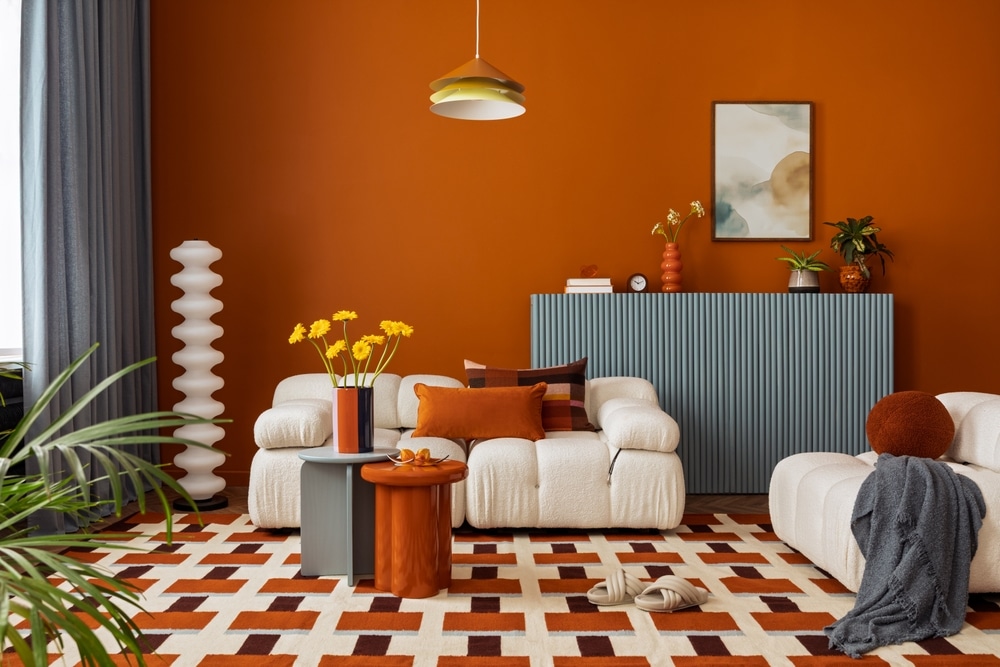
Second, match pattern density to the rest of the room. If your furniture is plain and solid, a patterned rug adds the personality the room is missing. If your sofa is bold, your curtains are floral, and your throw pillows are doing a lot, a quieter, neutral rug grounds everything. Patterned rugs hide stains beautifully, which is a bonus in high-traffic areas. Solid rugs look more elegant but show every bit of dirt.
Vintage-style rugs, faded Persian-inspired prints, and simple geometrics tend to be the safest “looks expensive” patterns. Avoid trendy abstract designs that scream a specific year — they’ll feel dated fast.
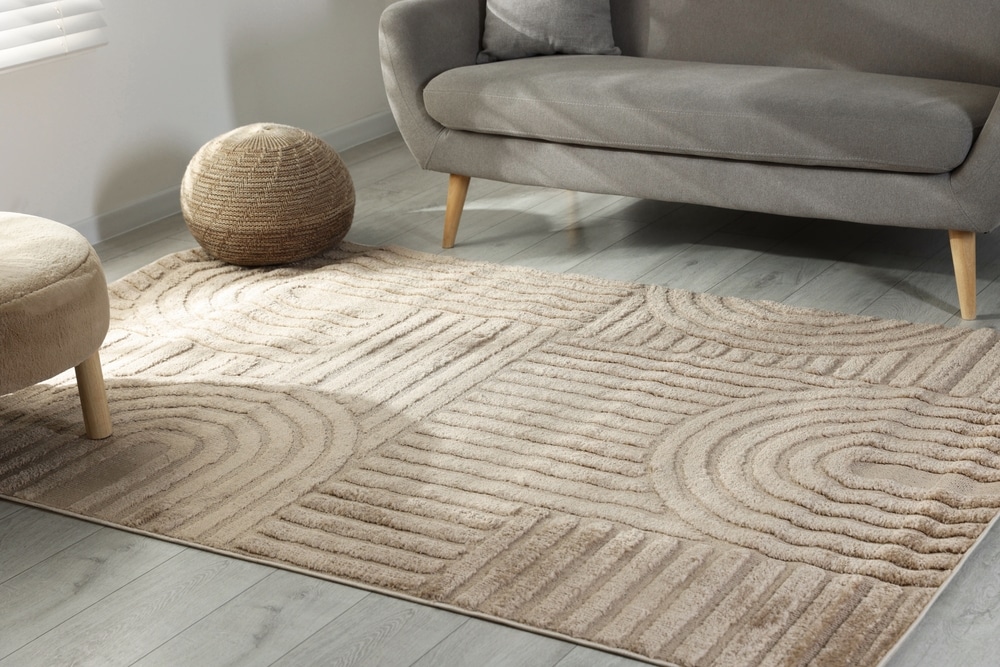
The Rug Pad — Don’t Skip This €15 Investment
Here’s a tip that almost no one mentions when discussing affordable rug ideas: buy a rug pad. A non-slip rug pad costs €15-25 and does three things: it keeps the rug from sliding, it makes a thin rug feel plusher underfoot, and — crucially — it extends the life of the rug by reducing wear from foot traffic and furniture pressure.
Skipping a rug pad on a budget rug is the fastest way to make it look worn out within a year. Spending an extra €20 to triple its lifespan is a no-brainer. This single move is what separates “I bought a cheap rug” from “I bought a rug that looks intentional and lasts.”
Layering: The Designer Trick That Costs Almost Nothing
Want a quick way to make a small or boring rug look like a deliberate design choice? Layer it. Place a smaller patterned rug or sheepskin on top of a larger neutral one, slightly off-center. This trick instantly makes spaces feel more layered and lived-in.
Layering also works in reverse: you can use a small rug you already own on top of a cheap, large neutral one to make both pieces look more intentional. It’s one of the easiest affordable rug ideas because you’re often working with stuff you already have.
Where to Place Rugs You Wouldn’t Normally Think Of
Most people only think of living rooms and bedrooms. But rugs work brilliantly in spots that often go bare. A small rug under a desk in a home office adds warmth and dampens chair noise. A runner in a kitchen between the sink and the island is both practical and stylish. A washable, low-pile rug in a bathroom is more interesting than a standard bath mat. An entryway runner makes a small first impression feel intentional.
These secondary spaces are perfect places to test cheap rugs without major commitment. Some of the best affordable rug ideas live exactly here, where you’d never spend big anyway.
Mistakes to Avoid
A few quick warnings. Don’t buy a rug online without checking the size against your actual space — tape it out on the floor first. Don’t buy a white or cream rug if you have pets, kids, or red wine in your life. Don’t pair a busy rug with busy furniture and busy curtains; something has to be quiet. And don’t ignore the smell test on cheap rugs — some synthetics off-gas for weeks. If you can, sniff before you buy, or air it out outdoors before laying it down.
A great rug doesn’t need to be expensive to transform a room. It needs to be the right size, in the right material, with a color that connects to what’s already there. The rest is just confidence and a rug pad. Now go measure your space, pick a budget, and pounce on a sale. Your floor — and your room — will thank you.
Do you want more amazing tips to improve your home on a budget? Then visit our Budget Home Ideas page right here