
Good budget window treatments are rarely about finding miracle curtains that look luxurious straight out of the package. The real trick is making inexpensive panels behave like custom drapery. That comes down to placement, proportion, fullness, fabric, and a few finishing touches—not a designer price tag.
Even basic ready-made curtains can look surprisingly polished when they are hung high, extended beyond the window, properly hemmed, and given enough fabric to form generous folds. Better still, many of these upgrades are reversible, making them practical for renters who cannot permanently alter the walls.
Here is how to create the expensive-curtain effect without spending heavily or upsetting your landlord.
Start With the Way Expensive Curtains Are Hung
One of the quickest ways to make curtains look cheap is to mount the rod directly above the window frame and end it exactly at the frame’s outer edges. This visually outlines the window, making both the glass and the room feel smaller.
Instead, treat the curtains as part of the wall.
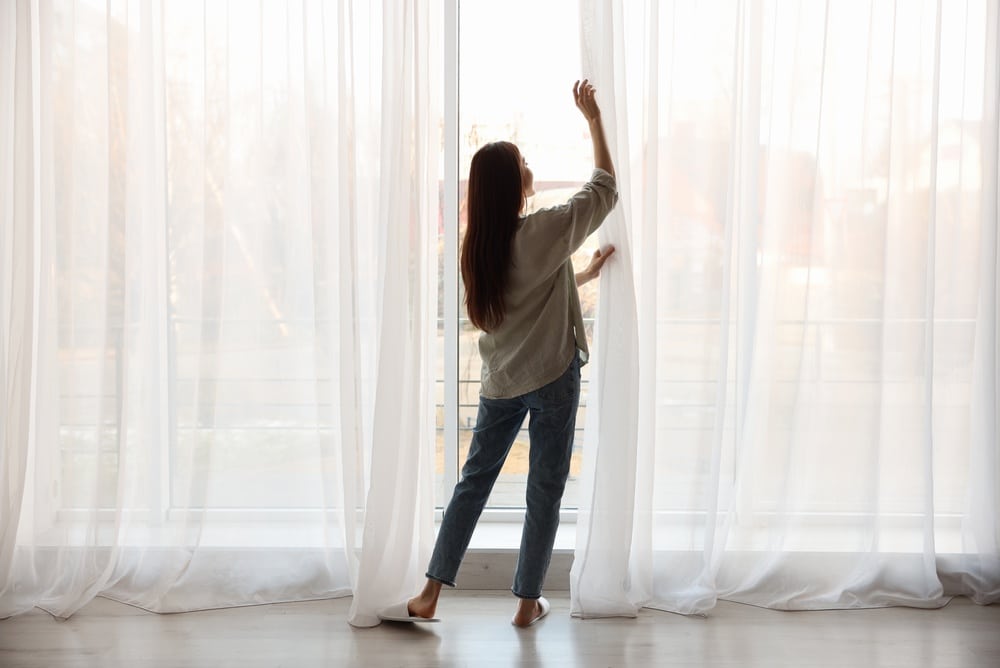
Whenever the room allows it, position the rod well above the window—either close to the ceiling or roughly halfway between the frame and ceiling. Extending the rod beyond both sides of the window also lets the open curtains sit mainly against the wall rather than covering the glass.
This arrangement creates taller vertical lines, exposes more daylight, and makes the window appear larger. IKEA’s curtain measuring guide recommends extending a curtain rod at least 15 centimeters, or about 6 inches, past each side of the window. You may want to go wider when there is enough clear wall space and the panels remain full when closed.
Before deciding on the position, check for nearby cabinets, radiators, inward-opening windows, vents, and furniture. Curtains should not prevent a window from opening or rest against a heat source.
Measure the Wall, Not Just the Window
Do not buy panels based only on the dimensions of the glass. First decide where the rod will sit, and then measure from that point down to your preferred finishing position.
For a tailored appearance, curtains can stop just above the floor or lightly touch it. This requires reasonably accurate measuring, especially in older rentals where floors and ceilings may not be perfectly level. Measure at the left, center, and right of the window before choosing a length.
A generous “puddle” of fabric can look dramatic in styled photographs, but it is less convenient in daily life. Excess fabric collects dust, interferes with vacuuming, and can become a target for pets. A slight break at the floor is more forgiving, while a clean floor-length finish is easier to maintain.
Avoid curtains that finish several inches above the floor unless something underneath the window requires it. That awkward gap tends to make ready-made panels look undersized.
Fullness Is the Real Luxury Trick
A curtain panel should not become almost flat when it is closed. Full, even folds are a major part of what makes custom drapery look substantial.
As a useful starting point, aim for a total fabric width that is around twice the width of the rod. A 72-inch rod, for example, would need approximately 144 inches of total curtain width. That could mean two wide panels or four narrower ones.
The ideal amount depends on the fabric and heading style. Lightweight sheers often need more material to look generous, while thick or heavily lined curtains can become bulky with too much. The Blinds.com guide to drapery fullness explains why fabric measuring twice the covered width produces fuller curtains when closed, with very light materials sometimes requiring even more.
This is where buying an extra pair of inexpensive panels can deliver a bigger visual improvement than buying one pair made from a slightly more expensive fabric. Four basic panels hung with convincing fullness will often look richer than two premium panels stretched thinly across a wide window.
Choose Fabric That Can Hold a Good Shape
You do not need silk or velvet, but fabric weight matters. Very thin polyester can reflect light in a way that emphasizes wrinkles and uneven stitching. Look for material with enough body to fall in long, controlled folds.
Affordable options that can work well include cotton blends, linen-look fabrics, brushed textiles, and matte polyester. Linen-look curtains are particularly useful because the visible texture creates interest without requiring a complicated pattern.
Be cautious with extremely shiny fabric, prominent printed designs, or anything that feels stiff and papery. Bold patterns must also align across multiple panels, which can make an inexpensive setup harder to pull off.
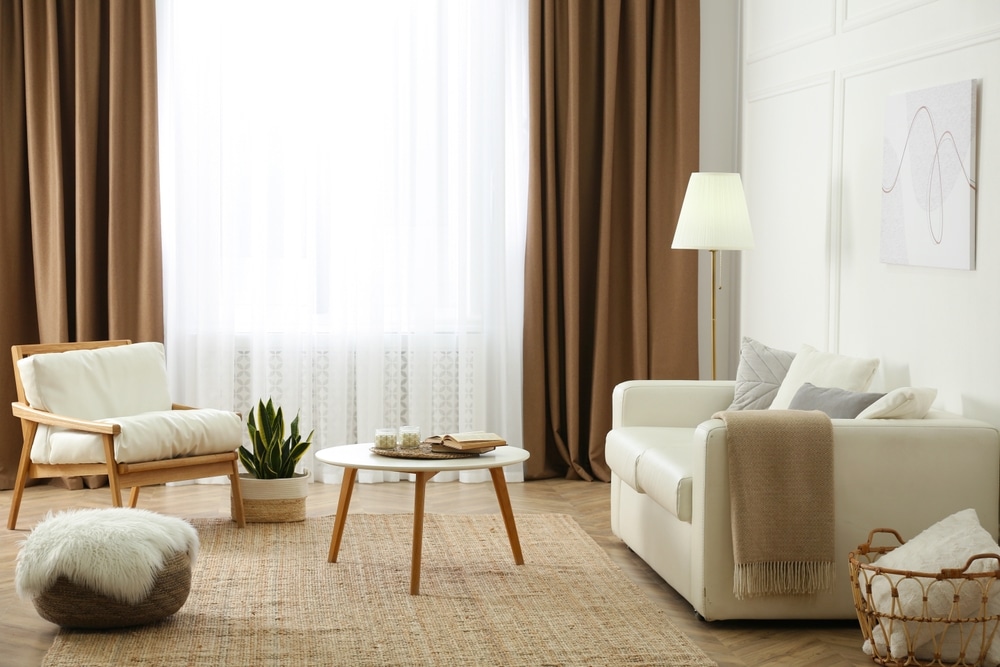
Neutral colors are not mandatory, but they make combining several low-cost panels easier. Warm white, oatmeal, stone, soft gray, olive, and muted blue can all look sophisticated. If the wall and curtains are similar in tone, the treatment tends to feel broader and more architectural.
Secondhand shops and resale platforms can be excellent sources of long curtains, particularly if you are willing to alter the length. Inspect used panels for fading, odors, damaged hems, and differences between supposedly matching pieces.
Fix the Length Without Paying for Alterations
Ready-made curtains come in fixed sizes, but walls do not. Fortunately, a simple hem can make budget panels look far more intentional.
If you can sew a straight line, pin the curtains while they are hanging, remove them, and stitch a new hem. Press the fold before sewing so the bottom edge remains crisp. Keep the original hem allowance where possible; a deeper hem adds weight and helps the curtain hang more neatly.
No-sew iron-on hemming tape is another option. Follow the tape manufacturer’s temperature instructions and test it on an inconspicuous part of the fabric first. Some synthetic curtains cannot tolerate high heat, and certain adhesives may show through very thin material.
Adjustable curtain clips can also shorten panels temporarily by folding excess fabric behind the top edge. This is useful for renters who may want the original length in a future home. However, make the fold consistent across every panel or the top will look uneven.
Do not shorten anything until the rod and hanging hardware are installed. Rings, hooks, clips, and rod pockets all position the fabric at slightly different heights.
Upgrade the Curtain Heading
Rod-pocket curtains are inexpensive, but they can be difficult to open and often bunch unevenly. They also hide most of the rod, which is not always the polished look you want.
Curtain rings with clips are an easy renter-friendly improvement. Space the clips evenly, fold the fabric slightly behind each attachment point, and train the curtain into consistent pleats. For a cleaner result, position the clips just below the top edge so they are less visible from the room.
If the panels have heading tape on the back, use proper curtain hooks and rings instead. This creates more controlled folds and makes inexpensive panels resemble pinch-pleat drapery. Some heading tapes allow different hook positions, which can also help fine-tune the finished length.
Whichever method you choose, use the same spacing on every panel. Uneven rings are far more noticeable than inexpensive fabric.
Make Cheap Hardware Look Deliberate
A thin rod struggling under heavy fabric immediately spoils the illusion. Choose a rod that is appropriately rated for the combined weight of the curtains, rings, and any lining.
Simple hardware usually looks better than ornate hardware pretending to be antique metal. A plain black, warm brass, dark bronze, or wood-look rod can provide a crisp finish without becoming the focus of the room.
If the window is wide, use the required center supports. A sagging rod is unattractive and may eventually pull its brackets loose. Keep finials simple and make sure the rod extends equally on both sides.
Matching hardware across windows in the same room also creates a custom feel. The rods do not need to be expensive; they just need to look coordinated.
Choose the Right Renter-Friendly Mounting Method
“No-drill” does not automatically mean “damage-free.” Adhesive products can pull off weak paint, tension rods can mark window recesses, and overloaded hooks can fall.
A tension rod works best inside a deep, square window recess and with relatively lightweight fabric. It is useful when drilling is prohibited, but it will not create the same high-and-wide effect as a rod mounted above the frame.
Adhesive hooks may support a lightweight rod if the particular hooks are designed for that purpose, compatible with the wall surface, and used within their stated load rating. Include the weight of the rod, curtains, clips, and anything else attached—not just the fabric.
Preparation and removal matter. For example, 3M’s instructions for its removable hooks specify surface preparation, waiting periods, temperature limits, and a slow stretch-release removal method. They also warn against use on wallpaper. Instructions vary by product, so never assume every adhesive hook has the same capacity or surface compatibility.
If small screw holes are permitted under your rental agreement, conventional brackets may be more reliable for long or heavy curtains. Confirm the rules with your landlord first, use the correct fixings for the wall, and plan to repair the holes properly before leaving.
Layer for a More Custom Look
Layered window treatments create depth and allow better control over privacy and light. A basic sheer behind an opaque curtain can look far more expensive than either one used alone.
You do not necessarily need a double rod. If privacy is already provided by an existing roller blind, keep it and add decorative curtains outside the frame. The blind handles daily light control, while the curtains soften the room and make the window appear larger.
Curtain liners are another useful upgrade. Blackout liners can reduce incoming light, while ordinary lining gives thin decorative fabric more body and helps it hang smoothly. Clip-in and detachable versions are convenient when you do not want to sew.
Remember that lining adds weight. Recheck the rod, brackets, hooks, and adhesive ratings before combining multiple layers.
Steam, Press, and Train the Folds
Fresh curtains rarely emerge from their packaging looking elegant. Creases, curled hems, and random folds will advertise that they came straight from a plastic bag.
Check the care label, then steam or iron the panels using a temperature suitable for the material. Hanging them while slightly damp may help with some washable fabrics, but do not rely on this when the manufacturer advises otherwise.
Once hung, arrange the fabric into even forward-and-back folds. Loosely tie each panel with strips of soft fabric and leave it in position for a few days. When the ties are removed, the curtains should retain a more orderly shape.
This costs nothing, yet it can make a bigger difference than decorative tiebacks or expensive finials.
Avoid the Details That Give the Game Away
The expensive look depends on restraint. Do not crowd the rod with too many different accessories, combine mismatched whites, or leave labels and loose threads visible.
Check that paired panels are genuinely the same length. Align patterns where possible, keep the opening centered, and place the outer edges symmetrically. If four panels are being used to create fullness, conceal the joins within the folds rather than spreading every panel independently.
Finally, spend according to the window’s needs. A seldom-used room may only need simple sheers, while a bedroom may justify blackout lining and stronger hardware. An inexpensive solution stops being economical if it falls repeatedly, blocks a heater, or fails to provide the privacy you need.
Expensive-Looking Curtains Are Mostly About Proportion
You can fake expensive curtains on a renter’s budget without pretending cheap fabric is something it is not. Hang the treatment higher and wider, use enough panels for real fullness, hem them to the correct length, keep the hardware simple, and remove every visible wrinkle.
Those choices create the long lines, generous folds, and tidy finish associated with custom drapery. Get the proportions right, and even very ordinary curtains can make the entire room look more considered.