
Living in a studio apartment or an open-plan home is a bit like wearing one continuous outfit — convenient, sometimes stylish, but eventually you really do want to separate the bedroom from the kitchen. The trouble is, putting up an actual wall isn’t usually an option, especially in a rental, and even when it is, it’s expensive and permanent. The good news is that a smart DIY room divider can carve up an open space beautifully without renovation, without your landlord’s wrath, and without spending the kind of money that requires therapy afterward. We’re talking visual zones, real privacy where it matters, and rooms that actually feel like rooms.
The trick is matching the right kind of divider to the right kind of problem — and there are more options than most people realize.
Why Open Spaces Need Some Closing
There’s a particular feeling that hits around month three of living in a studio: you can see your bed from your dinner table, your couch from your toilet area, and your work-from-home desk from absolutely everywhere. Open spaces sound dreamy in real estate listings, but they wear on you. The brain genuinely needs visual zones to mentally switch between activities — sleep, work, eat, relax. Without them, everything blurs.
A well-placed DIY room divider doesn’t just look nice. It changes how the space functions and how it feels to live in. It signals to your brain “this is the sleeping zone” or “this is where work happens,” and that mental separation is genuinely valuable, especially for anyone working from home in a small apartment.

The Bookshelf Trick (Probably the Best One)
If you ask designers for the single most reliable DIY room divider, most of them point at a bookshelf. There’s a reason. A bookshelf does three jobs simultaneously — it visually separates two zones, it stores stuff, and it lets light pass through if you choose an open design. That last part is critical. A solid wall blocks light and makes both halves of the room feel smaller. An open shelving unit divides while still letting the space breathe.
The IKEA Kallax is the unofficial king of this category. It’s affordable, comes in multiple sizes, can be styled with bins or left fully open, and looks intentional from both sides. Mount it perpendicular to a wall and you’ve got an instant zone separator. Style each side differently — books and plants on the living-room side, baskets and a small lamp on the bedroom side — and the same piece does double design duty.
For renters, a tall bookshelf as a DIY room divider is genuinely the lowest-effort, highest-impact solution there is. No drilling, no permanent changes, fully reversible when you move.
Curtains: The Most Underrated Solution
People dismiss curtains as a divider option because they assume they look temporary or makeshift. Done well, they don’t. A floor-to-ceiling curtain in a heavy linen or velvet, hung from a ceiling-mounted track, looks remarkably elegant — almost theatrical in the best way.
The beauty of a curtain DIY room divider is flexibility. Pull it closed when you want privacy (sleeping, video calls, hosting), pull it open when you want the space to feel large again. It costs less than almost any other option — a tension rod, a curtain track from IKEA, or even a thin steel cable strung across the ceiling, plus a curtain panel from any home store. Total cost: often under €40.
For renters who can’t drill into ceilings, tension rods spanning between two walls work beautifully. If your studio has exposed beams or pipes, you can sometimes attach to those instead. Sheer curtains divide visually without blocking light; heavier curtains create real privacy and dampen sound. You can even layer the two for adjustable atmosphere.
When Furniture Becomes the Wall
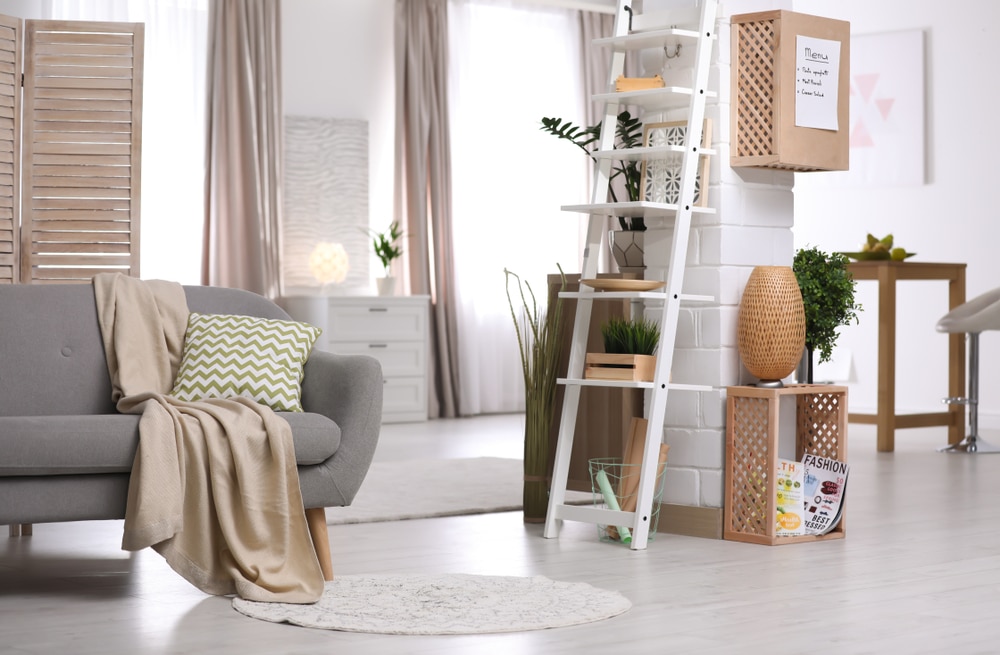
Sometimes the best DIY room divider isn’t a divider at all — it’s just furniture placed thoughtfully. A long sofa with its back facing the bed creates a clean visual line between living and sleeping zones. A console table behind that sofa adds height. A tall plant in a planter on the console adds another layer. Suddenly you have a clear three-dimensional separation built entirely from things people normally already own.
A clothing rack — yes, a regular open garment rack — works surprisingly well, especially in studios where wardrobe storage is already a problem. It divides space and stores clothes simultaneously. Add a small curtain to one side and it becomes a makeshift dressing area too.
A desk angled into the room rather than pushed against a wall can carve out a work zone. A tall dresser at the foot of a bed acts as a low partition. A kitchen island on wheels separates cooking from living. The principle here: anything tall enough to break a sightline can function as a DIY room divider if you place it right.
The Folding Screen Comeback
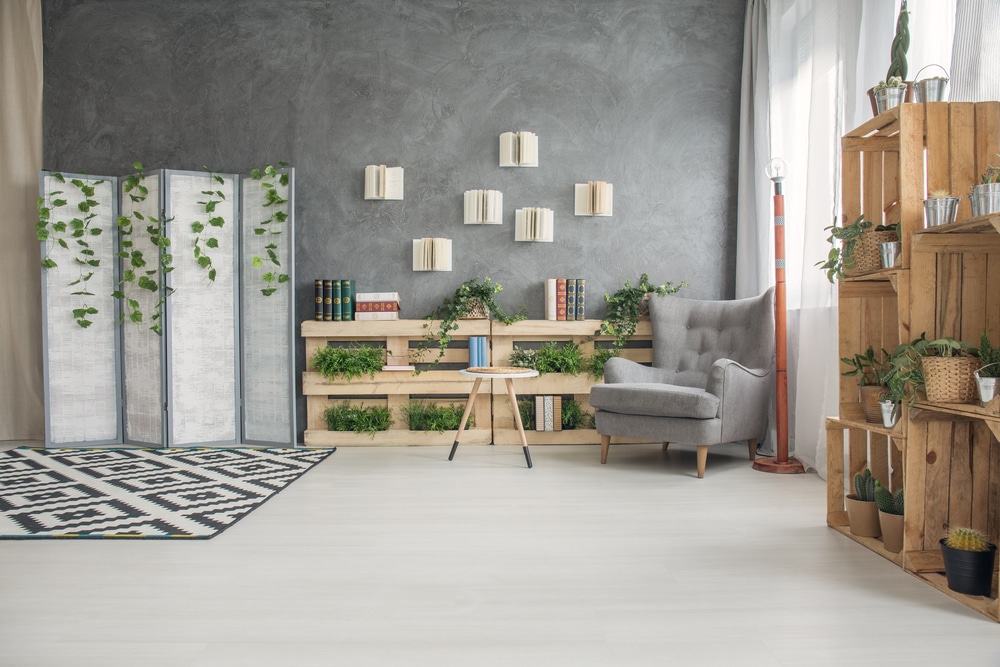
Folding screens — those classic three- or four-panel partitions — went out of fashion for a while and are quietly back, especially in rentals. They’re portable, fold flat for storage, require zero installation, and come in styles ranging from rattan and bamboo to slatted wood and printed fabric.
A vintage folding screen is genuinely one of the most interesting-looking DIY room divider options out there. Thrift stores and second-hand sites like Marktplaats and Vinted often have beautiful older models for €30-80 — much better-looking than what you’ll find new at the same price point. Spray paint or a fabric refresh can update an outdated screen in an afternoon.
The downside is that they don’t go floor-to-ceiling, so they’re better for visual zoning than for true privacy. But for “I just don’t want to see my bed from the dinner table,” they’re perfect.
Plants as Walls
A row of tall plants makes a genuinely beautiful DIY room divider, particularly in spaces with good natural light. Snake plants, fiddle leaf figs, areca palms, and tall bamboo can all create vertical greenery that visually separates without feeling oppressive. The space stays open, light still passes through, and you’ve added something living to your home.
A long, narrow plant stand or a row of identical floor planters lined up creates the structure. For more vertical impact, a tall ladder shelf with cascading pothos and ferns becomes a green wall over time. This kind of DIY room divider has the bonus of being genuinely calming — there’s solid research that being around plants reduces stress.
For non-plant-people, faux plants have come a long way and look surprisingly real, especially in lower-light situations where real plants would struggle anyway.
Slatted Wood Walls (For the Slightly Ambitious)
If you’re comfortable with basic DIY and have permission to make some holes, a slatted wood partition is one of the most beautiful DIY room divider options possible. Vertical wood slats spaced a few centimeters apart create rhythm, let light filter through, and look like something from a high-end design magazine.
The build is simpler than it looks: a top and bottom rail, vertical slats screwed in at even intervals, the whole thing either freestanding (if heavy enough at the base) or anchored at top and bottom. Pine slats from any hardware store cost very little, and a coat of stain or matte black paint upgrades the whole look. Total project cost: typically €60-120 depending on dimensions.
This is the DIY room divider that makes apartments look custom-designed. People will assume you hired someone.
The Hanging Solution
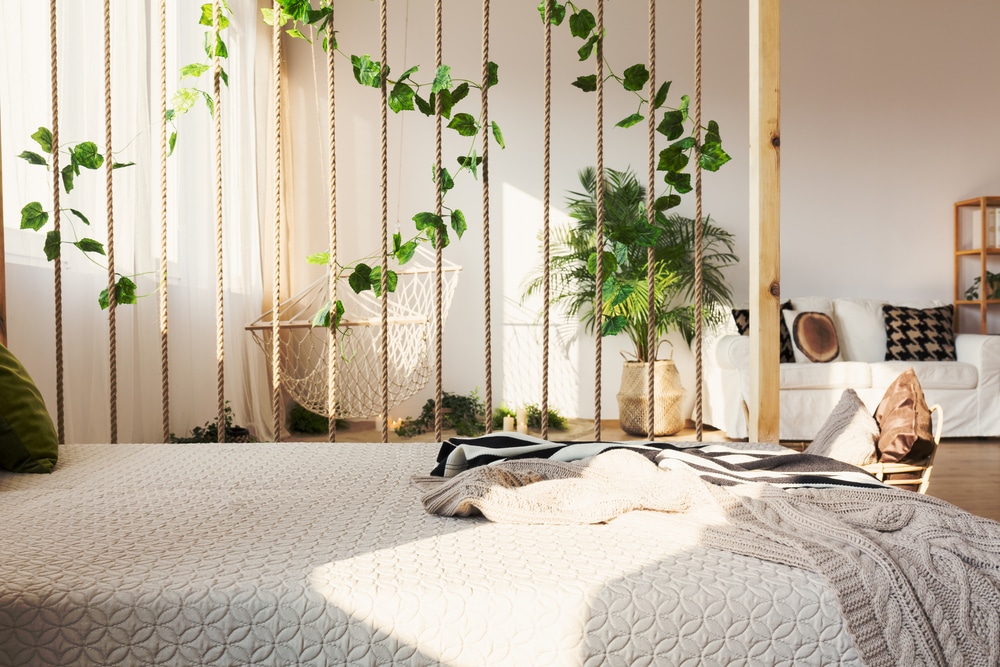
For renters who can’t put anything on the floor or who need flexibility, ceiling-hung dividers solve the problem. Hanging fabric panels, a row of macramé pieces, beaded curtains in a doorway, or even strings of dried flowers or vines can mark a transition between zones without taking up floor space.
The hardware is simple — ceiling hooks (some are removable and don’t damage paint), a tension wire, or a discreet curtain track. The look can be anything from bohemian to minimalist depending on what you hang. This kind of DIY room divider is especially good in tiny studios where every floor centimeter is precious.
Combining Multiple Dividers
Here’s the move designers use that most amateurs miss: layering. A single divider often isn’t enough to truly separate zones — but two or three subtle ones working together absolutely is. A bookshelf at one angle, plus a curtain partway across, plus a different rug under each zone, signals “these are separate rooms” far more effectively than any single object can.
Different rugs are particularly underrated. Two different rugs in two different zones do more for visual separation than people realize, even without any vertical divider. Combined with a half-height bookshelf or a sofa back, it’s complete.
Mistakes Worth Avoiding
A few warnings. Don’t pick a DIY room divider that completely blocks light if you only have one window — you’ll make both halves of your space feel like caves. Don’t go too short, either; a partition under chest height barely separates anything visually and just becomes a piece of furniture. Don’t ignore the back of the divider; if it’s facing your living area, it needs to look as good as the front. And don’t anchor anything heavy to drywall without proper supports — falling bookshelves are not a fun studio apartment surprise.
You don’t need a wall to have rooms. The right DIY room divider — whether it’s a bookshelf, a curtain, a folding screen, a row of plants, or a custom slatted wood panel — can make a studio feel like a one-bedroom and an open plan feel like a properly zoned home. Match the divider to the problem, layer when needed, and remember that flexibility is often more valuable than permanence.
Now go look at your space with fresh eyes. There’s almost certainly a wall waiting to happen — without any actual construction.
Do you want more amazing tips for DIY Projects in your home? Then visit our DIY Projects page right here