
Most of us inherited our cleaning supply storage system from our parents, which means most of us are doing it wrong. Under the kitchen sink. That’s where everything goes, right? Bleach next to dish soap, oven cleaner crammed beside the dishwasher pods, a spray bottle of something blue that nobody remembers buying. It’s the universal default, and for most homes, it’s a quiet disaster — both for safety and for sanity. If you’ve ever stood there moving six bottles to find one, you already know your system needs help. Let’s talk about how to actually organize cleaning supplies in a way that works for real life, not just for Pinterest.
The good news: this is a problem that doesn’t require buying anything fancy. It just requires thinking about your home a little differently than you’ve been told to.
The Under-The-Sink Myth
Here’s a small revelation that genuinely changes how people approach this. You don’t have to keep everything under the kitchen sink. You probably shouldn’t. That cabinet is one of the most valuable storage zones in your kitchen — it’s at hip height, easy to access, and large. Filling it with rarely-used heavy-duty cleaners is like using a private parking spot for a car you drive twice a year.
Cleaning experts increasingly recommend a more distributed approach. Keep daily kitchen supplies — dish soap, a countertop spray, a magic eraser, dishwasher pods — under the sink because that’s where you use them. Move everything else somewhere smarter. The rest of this article is about that “somewhere smarter.”
When you organize cleaning supplies this way, two things happen at once: your kitchen storage opens up dramatically, and your actual cleaning gets faster because supplies live near where you use them.
Think in Zones, Not Closets
The single biggest mindset shift here is moving away from “one cleaning closet for everything” toward zone-based storage. The logic is simple. You clean the bathroom in the bathroom. You clean the kitchen in the kitchen. Walking back and forth fetching supplies from a single central closet wastes time and makes you less likely to clean little messes when they happen.
So when you organize cleaning supplies, group them by where the cleaning actually takes place. Bathroom cleaners belong in the bathroom — high up, behind a closed door, but in the bathroom. Kitchen cleaners belong in the kitchen. Floor and whole-house cleaners can live somewhere central. It sounds obvious when you say it out loud, but the number of homes that store all their cleaners in one cabinet and then truck them around the house is enormous.
This zone approach is also how cleaning professionals organize cleaning supplies in the homes they manage. They don’t haul giant caddies between rooms. They keep what’s needed where it’s needed.
The Bathroom: Higher Than You Think
Bathrooms are the trickiest zone because they’re small, often shared with kids, and full of moisture. The default move is shoving everything under the bathroom sink, which is fine for a few items but quickly becomes a damp, chaotic mess.
A better setup: use the inside of a cabinet door for most-used items. Adhesive caddies or a slim over-the-door rack can hold a glass cleaner, a disinfecting spray, and a packet of wipes — visible, accessible, and off the floor of the cabinet. Heavy-duty cleaners (toilet bowl cleaner, mildew remover) can go higher up, on a shelf above eye level, especially if you have small children. The general rule from poison control experts is simple: dangerous chemicals belong above a child’s reach, in their original containers, with lids tightly closed.
Don’t store cleaning supplies in the same cabinet as towels, toilet paper, or anything that could absorb leaks. A bottle that drips onto a stack of clean towels is a small horror you only need to experience once.
The Kitchen: Less Than You Think
If you organize cleaning supplies properly, your under-sink kitchen cabinet should hold surprisingly little. Dish soap, a multi-surface spray, dishwasher pods (in a child-resistant container if needed), maybe a stash of microfiber cloths, and that’s it. Possibly a small caddy for grabbing-and-going.
The reason for the minimalist approach: kitchens are where food meets surfaces, and you don’t want a leaking bottle of oven cleaner sitting next to where you store your sponges. Heavier-duty kitchen cleaners — degreasers, oven cleaners, drain cleaners — should live elsewhere and only come out when needed.
A clear plastic caddy or basket inside the cabinet contains drips and spills. If something leaks, you wash the basket, not the entire cabinet. This single tip is one of the most underrated tricks for anyone trying to organize cleaning supplies in a small kitchen.
The Real Hero: A Dedicated Cleaning Cabinet
Most homes need one central spot for everything that doesn’t have a room-specific home. The laundry room is ideal if you have one. A utility closet works. A tall cabinet in the hallway, the back of a coat closet, or a shelf in the basement all qualify. Even a top shelf in a pantry can work, as long as cleaners are physically separated from food.
This is where you organize cleaning supplies that you use less frequently or that need to stay out of reach: bleach, ammonia-based cleaners, drain unblockers, oven cleaner, carpet cleaner, anything labeled with a serious warning. It’s also where backstock lives — the spare bottle of laundry detergent you bought on sale, the extra pack of paper towels, the sponges in bulk.
A few rules for this central cabinet. Keep it cool, dry, and well-ventilated. Heat and humidity break down chemicals and warp plastic. Don’t store cleaners in a freezing garage either — extreme cold can damage some products. And critically: never store chemicals that can react with each other near each other. Bleach and ammonia, for instance, should not share shelf space. Their fumes can become genuinely dangerous if both bottles leak simultaneously.
The Tools Nobody Knows Where to Put
Mops, brooms, vacuums, dust pans — the awkward stuff. These don’t fit in cabinets, they’re too big to hide, and they tip over constantly. The trick is to give them vertical space.
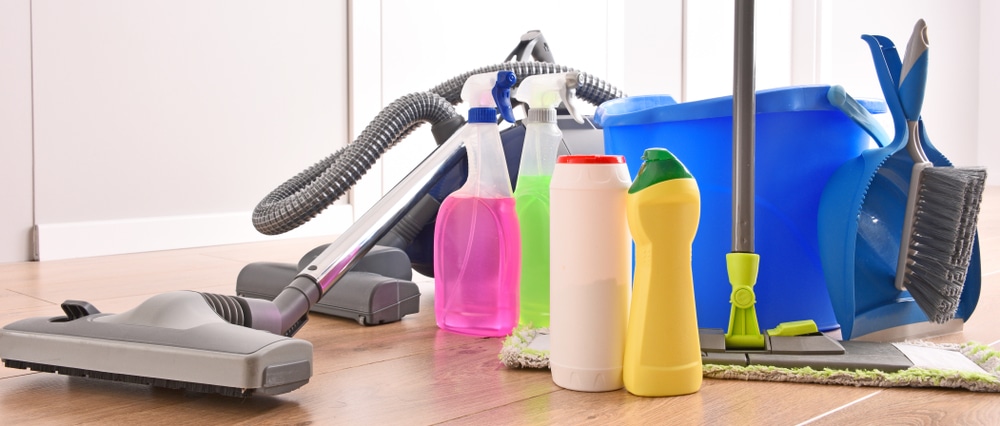
A tall narrow utility closet is ideal, with hooks or a wall-mounted rack to hang mops and brooms upright (storing them resting on their bristles destroys them). If you don’t have a closet, a behind-the-door wall-mounted broom organizer (you can find these for under €15) turns any door into vertical storage. Vacuums can usually live in a coat closet or a corner of a laundry room.
When you organize cleaning supplies in a tight space, going vertical is non-negotiable. Floor space disappears fast. Wall and door space is almost always wasted.
The Caddy Trick That Saves Saturday Mornings
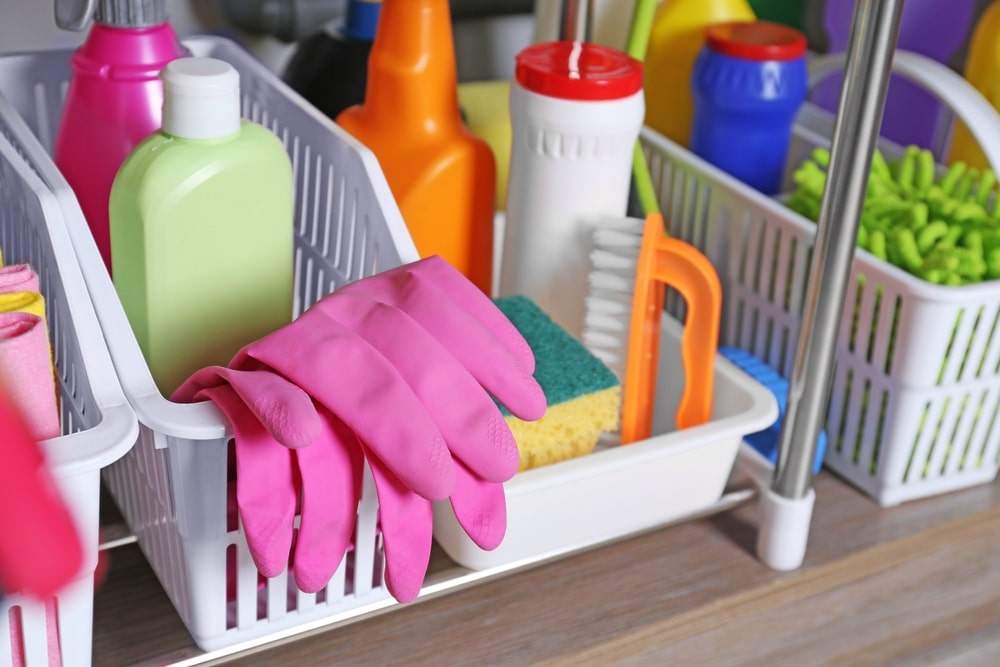
One small purchase changes everything: a portable cleaning caddy. A plastic caddy with a handle, around €5-10, holds your essential weekly cleaners and travels with you from room to room.
Stock it with the basics: an all-purpose spray, a glass cleaner, a disinfecting wipe pack, a few microfiber cloths, a sponge, and a small brush. When it’s Saturday cleaning time, you grab the caddy and go. No twelve trips back to the kitchen for the one thing you forgot. When you’re done, the caddy returns to its home (the central cabinet or laundry room) until next week.
This is genuinely how professional cleaners work, and it’s one of the simplest moves you can make to organize cleaning supplies for your own routines. A caddy turns “I need to clean the whole house” from a project into a single trip.
What About Safety?
If you have kids or pets, you cannot organize cleaning supplies the same way you would in a child-free home. The data on this is genuinely sobering — the American Association of Poison Control Centers has documented thousands of incidents involving children and household chemicals, particularly with brightly-colored products like dishwasher pods, which young kids mistake for candy.
The basic rules: anything with a serious warning label goes above a child’s reach, ideally behind a locked door. Use child-safety locks on cabinets that contain anything dangerous. Never decant cleaners into unlabeled containers — old soda bottles or random jars are how accidental poisonings happen. Always keep products in their original containers with the original labels intact.
For pets, the same principles apply. Cats can get into surprisingly high cabinets. If you have a curious one, locked storage is worth it.
Getting Rid of What You Don’t Need
The fastest way to organize cleaning supplies effectively is to have fewer of them. Most homes have triple the cleaning products they actually need. Specialty cleaners for stainless steel, for granite, for leather, for stove tops, for grout — most can be replaced by an all-purpose cleaner, glass cleaner, dish soap, and baking soda.
Pull everything out, check expiration dates (yes, cleaners expire — usually after 1-2 years for most products, faster for natural ones), dispose of anything bulging or damaged, and combine duplicates. Most people are stunned by how much they can throw out. A leaner stash is easier to organize, easier to maintain, and cheaper in the long run.
Organize cleaning supplies: The Real Goal
Once you’ve sorted, zoned, and stocked, the system mostly maintains itself. Put things back where they belong. Restock the caddy. Replace bottles when they run low. The hard work is in the initial overhaul — once it’s done, daily upkeep takes minutes.
The point of all this isn’t a magazine-worthy cleaning closet. It’s that cleaning becomes faster, safer, and less mentally taxing. When you organize cleaning supplies thoughtfully, you stop hunting and start cleaning. That’s the whole win.
Now go look under your kitchen sink. You probably have some work to do.
Do you want more amazing tips to reorganize your home? Then visit our home organization page right here